
Tree removal and tree care across Wahroonga's two council areas
Wahroonga (2076) has a detail that changes how tree work is planned: the suburb is split between Ku-ring-gai Council and Hornsby Shire. The two councils word their tree rules differently, so the first step for any removal or heavy pruning is working out which one covers your address.
Below you will find both sets of rules, what drives the price of a job, how large trees are taken down near houses, and the options for trees you want to keep. The work is done by an insured team based in Beecroft, which has worked across Sydney's north west since 2004 and is a member of Arboriculture Australia.
Tree services we provide in Wahroonga
The council split affects the paperwork, not the work. On both sides of the boundary the crew offers:
- Removal of large trees: dismantled limb by limb near the house, with a crane where the site calls for one.
- Pruning: crowns lightened, reduced or raised, and limbs cut clear of the roof, so the tree can stay.
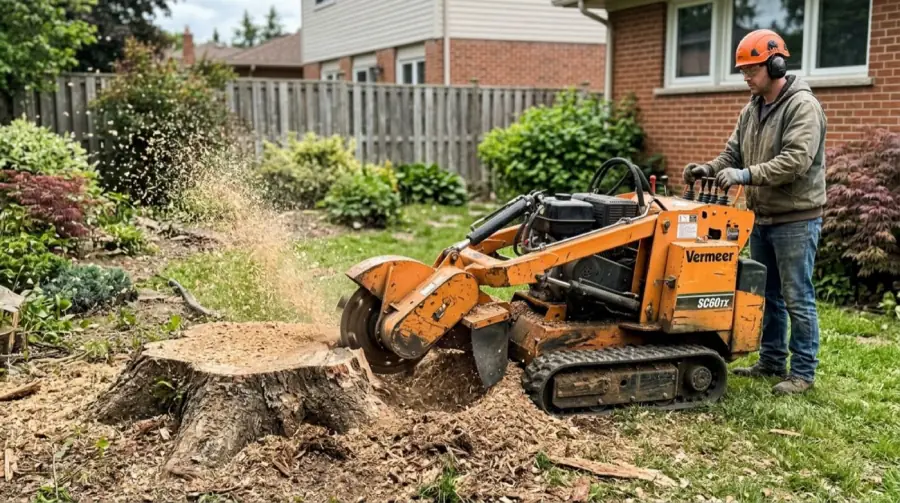
- Stump grinding: added to a removal, or booked for a stump that is already there.
- Palm cleaning and hedge trimming: fitted into the same booking as other tree work.
- Storm damage: downed trees and branches cleared after bad weather.
- Clean-up: green waste taken away, or mulch and firewood kept for you.
For more on any of these, browse all our tree services.
First step: is your address Ku-ring-gai or Hornsby Shire?
Because the suburb straddles two council areas, neighbours on either side of the boundary can face different rules for the same kind of tree. Your rates notice names your council; if in doubt, search your address with each one before planning anything.
Properties on the Hornsby Shire side follow the rules on Hornsby's trees on private property page. Properties on the Ku-ring-gai side follow the council's trees on your property page. Both are summarised below.
Tree rules on the Ku-ring-gai side
Ku-ring-gai's starting point is simple: a tree application must be submitted for any work on trees or vegetation where an exemption does not apply. So the real question for a Ku-ring-gai address is whether your job is exempt, and if it is not, you apply before work starts.
- What counts as a tree. Under the council's Tree and Vegetation DCP (Part 13), a plant 5 metres or more in height, or with a trunk 150mm or more across measured at ground level.
- Heritage. Trees on a heritage item property or in a Heritage Conservation Area are included.
- Your address. The council's online map shows which application process applies to a given property.
Tree rules on the Hornsby Shire side
Hornsby Shire starts from the position that pruning or removing a tree on private property generally needs a permit. One of the council's qualified arborists assesses each application.
- Nuisance branches. Live branches causing a nuisance, for example touching the roof, can be pruned by up to 10% of the canopy without a permit. Pruning beyond that, or for any other reason, needs one.
- Dead or dangerous trees. A dead tree that is not native wildlife habitat, or a tree that is an imminent risk, can come out without a permit after the council receives photo or video evidence and/or an arborist's written statement.
- Protected land. These exemptions do not apply in a Heritage Conservation Area, a Locally Significant Ecological Community, or an Endangered or Critically Endangered Ecological Community, including its 50m buffer.
- Owner's signature. The application must be signed by the property owner, not a tenant. Lodging and payment can both be done online.
Who handles the council application
In both council areas, the application is made by the property owner. What the crew can do is help you get there with fewer surprises. At the free quote visit, the arborist looks at the tree and tells you whether it is likely to need approval under your council's rules. The written quote then sets out exactly what work is proposed, so you know what you would be asking the council to allow.
Once the council has answered, the job is booked. Nothing is cut before then.
Pricing a Wahroonga tree job: the factors
Tree work has no price per metre, because the tree is only part of the job. The arborist assesses these on site:
- Height and spread. A large tree means more climbing, more cuts and more timber.
- Access. Gear wheeled in from the street, or carried through a side gate, up steps or across a slope.
- What is below. Roofs, pools, glasshouses, fences and wires mean every section is lowered with control.
- Equipment. Some removals are best done with a crane.
- Stumps and leftovers. Grinding the stump, keeping the mulch or having firewood cut all change the scope.
All of it goes into a single written figure, fixed and including GST.
Bringing down a large tree near the house
Big trees close to homes are where method matters most. Rather than felling, a climbing arborist dismantles the tree in stages from the top of the crown. Limbs are roped before they are cut, then lowered through pulleys to the ground crew, so their weight is controlled the whole way down. Where a tree is very large or hemmed in, a crane can lift sections over the house to a clear spot, which keeps the impact on lawns, driveways and garden beds low.
The crew works outside only, so you do not need to be there, and the property is cleaned up before they leave. Removals are usually for trees that are dead, diseased, storm-damaged, causing root problems or in the way of building work, and a free tube-stock tree is offered with each one.
Other tree maintenance options
Removal is not the only answer for a tree that is causing trouble. Pruning to AS 4373-2007, the Australian Standard for Pruning of Amenity Trees, often solves the problem and keeps the tree.
- Crown thinning takes out selected branches so a dense canopy lets more light and wind through.
- Crown reduction brings a tree back to a size that suits its position.
- Crown lifting raises the lowest limbs to clear driveways, paths and lawns.
- Deadwood removal takes out dead branches before they fall.
- Clearance pruning keeps limbs off wires, gutters, roofs, chimneys and windows.
- Palm cleaning removes old fronds and seed pods.
- Hedge and shrub trimming can be done on the same visit.
On the Hornsby side, keep the 10% nuisance limit in mind. On the Ku-ring-gai side, remember that pruning is work on a tree too, so check whether it is exempt first.
Grinding out stumps after a removal
A stump left in the ground gets in the way of mowing, paving and replanting. Grinding takes it out below the surface. Because the crew carries grinders in several sizes, stumps can be reached in front and back yards, at the top of steps, on sloping ground and beside fences or retaining walls. It can be quoted together with the removal or on its own.
Choosing a tree service for a Wahroonga property
Before anyone climbs a tree beside your house, a few points are worth checking:
- Insurance. This crew carries $20 million in public liability cover and will send a copy on request.
- Track record. Tree work across Sydney's north west since 2004, and membership of Arboriculture Australia.
- Council know-how. In a suburb split between two councils, your contractor should be able to explain both sets of rules.
- A written price. A fixed quote including GST that describes the work.
The same team covers Turramurra, Normanhurst, Waitara and the wider Upper North Shore, and clears fallen trees and branches after storms. If anything is touching powerlines, stay away and contact your electricity distributor. To book a free visit, call 02 9133 4095 or use the quote form; work runs Monday to Friday, 7am to 5pm, with weekends by appointment.
Wahroonga tree removal questions
How much will it cost to remove my tree in Wahroonga?
It depends on the tree's size, the access, what lies under the canopy, whether a crane is needed and whether you want the stump ground. An arborist inspects it for free and sends a fixed written price including GST.
Do I need Ku-ring-gai Council approval to remove a tree in Wahroonga?
If your address is on the Ku-ring-gai side, a tree application is needed for work on a tree unless an exemption applies. A tree there is a plant 5 metres or taller, or with a trunk 150mm or more across at ground level. The council's online map shows the process for your address.
Do I need council approval on the Hornsby Shire side of Wahroonga?
Generally, yes. Hornsby Shire requires a permit for most pruning or removal on private property. Exceptions include nuisance pruning of up to 10% of the canopy, and removing a dead tree that is not wildlife habitat, or an imminent risk, once the council has evidence.
Can you assist with obtaining council approval for tree removal in Wahroonga?
The application is made by the property owner. At the free visit the arborist can indicate whether the tree is likely to need approval, and the written quote describes the work so you know what you are applying for.
Is insurance coverage included with your tree services in Wahroonga?
Every job is covered by $20 million public liability insurance. You can ask for a copy of the policy before the work is booked.
Is there a standard price to remove a tree in NSW?
No. Two trees of the same height can be very different jobs depending on access and what is underneath, so each one is quoted after it has been seen.
What other tree maintenance options are available in Wahroonga?
Crown thinning, reduction and lifting, deadwood removal, clearance pruning around roofs and wires, palm cleaning, and hedge and shrub trimming, all done to AS 4373-2007.
How is my property protected while a big tree comes down?
The tree is dismantled from the top, with each section roped and lowered through pulleys, and on some jobs a crane lifts sections clear of the house. The crew stays outdoors and cleans up before leaving.
Tree removal near Wahroonga
We also work in the suburbs around Wahroonga:
- Tree removal Waitara
- Tree removal Normanhurst
- Tree removal Turramurra
- Tree removal Hornsby
- Tree removal Thornleigh
- Tree removal Asquith
- Tree removal Westleigh
- Tree removal St Ives
Ready to get a price? Request a free quote or call 02 9133 4095.