
Hornsby tree work: who signs off, what is exempt and how it gets done
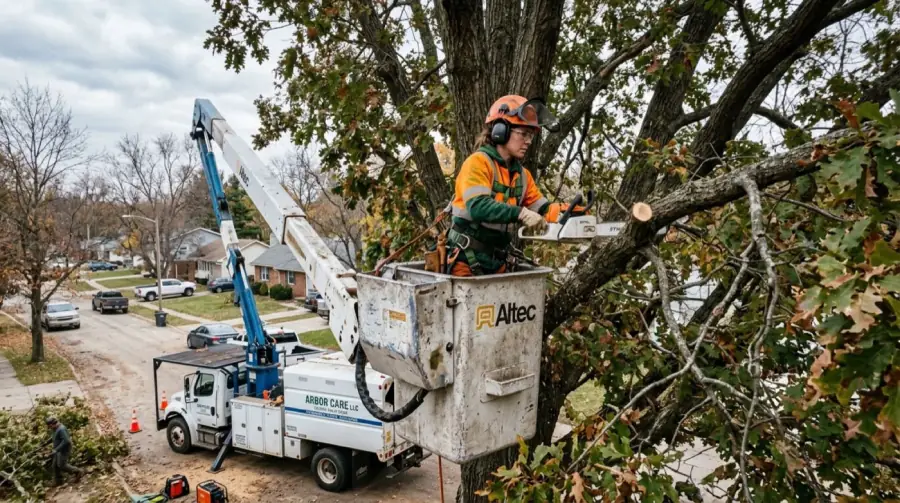
Before any tree work starts in Hornsby, two questions need answers: who is allowed to approve the job, and whether Hornsby Shire Council has to approve it as well. This page deals with both, then explains how tree removal, pruning and stump grinding are carried out in Hornsby 2077.
The work is done by an insured team based in Beecroft, about 6 km from Hornsby. It has looked after trees across Sydney's north west since 2004 and is a member of Arboriculture Australia. No job is priced until someone has seen the tree, and the price you receive is fixed and in writing.
Hornsby tree services we carry out
Whatever the council decides about your tree, these are the jobs our crew handles across Hornsby 2077:
- Tree removal: large trees taken down a section at a time, with a crane brought in for some jobs.
- Tree pruning: thinning, reduction, lifting and deadwood cuts that follow AS 4373-2007.
- Stump grinding: a grinder chosen to suit awkward or sloping yards.
- Hedge and shrub trimming: added to a pruning visit so the garden is finished in one go.
- Storm damage clean-up: downed timber removed and unsafe trees dealt with.
- Land clearing: whole sites cleared before construction begins.
Each one is described in more depth on our tree services page.
Who can give permission for tree work at a Hornsby property
Hornsby Shire Council is firm on one point: an application to remove or prune a tree must be signed by the property owner. A tenant cannot give that permission, even for a tree in the yard they use every day.
- Owner-occupiers can arrange the quote visit, decide what is done and sign any application themselves.
- Renters should raise the tree with the landlord or managing agent. You can still arrange the free quote so the owner has a written description and price to consider, but the decision, and any council application, rests with them.
- Units and strata blocks: the resident living beside a tree is often not the person who can sign for it. Find out who acts for the owners before any work is booked.
- Owners who live elsewhere do not need to travel. The crew works outdoors, never needs to come inside, and nobody has to be home on the day.
Work Hornsby Shire allows without a permit
The council's starting position is that pruning or removing a tree on private property needs a permit. The exceptions are narrow.
Nuisance pruning. Live branches that are causing a nuisance can be cut back without a permit. The council's own example is a branch touching the roof. The limit is 10% of the tree's canopy. If the reason for the cut is something other than a nuisance, the exemption does not cover it.
Dead or dangerous trees. A tree that is dead, and is not native wildlife habitat, can be removed without a permit. So can a tree that poses an imminent risk. In both cases the council has to be given evidence first: photos or video, a written statement from an arborist, or both.
Where the exemptions stop applying. None of this covers land in a Heritage Conservation Area, a Locally Significant Ecological Community, or an Endangered or Critically Endangered Ecological Community, including the 50 metre buffer around one. On those properties, speak to the council before a single branch is cut.
When a Hornsby Shire permit is needed
Removing a healthy tree, pruning more than 10% of a tree, or pruning for any reason that is not a nuisance all need a permit. Each application is assessed by one of the council's qualified arborists.
- The form is the council's application to remove or prune trees and vegetation.
- It must carry the property owner's signature.
- It can be lodged and paid for online.
The current form and the full rules are on the council's trees on private property page. At the free quote visit, the arborist looks at your tree with these rules in mind and tells you whether a permit is likely to be needed. The owner then lodges the application, and the work is booked once the council has answered.
How your property is protected while a tree comes down
Most removals happen close to a roof, a fence, a pool or the garden next door, so the method keeps falling timber away from all of them.
- Top-down dismantling. A climbing arborist works from the crown downwards, cutting the tree into manageable pieces instead of dropping it whole.
- Controlled lowering. Limbs and trunk lengths are tied off and let down on ropes and pulleys, so they land where the ground crew wants them.
- A crane where it helps. On some jobs a crane lifts sections clear of the house, which keeps the impact on lawns, paving and garden beds low.
- Outdoor work only. Nobody needs to enter your home.
- A tidy finish. The property is cleaned up once the work is complete.
If a tree or branch has come into contact with powerlines, for example after a storm, stay well clear and call your electricity distributor before anything else.
When removal is the right call
Taking a tree out is usually the answer when it is dead or diseased, has been badly damaged in a storm, has roots causing problems, or stands where a building or extension has to go. For larger development sites, the crew also handles land clearing.
A free replacement tree in tube stock comes with every removal, so the garden does not lose its greenery for good. You also decide what happens to the waste: the mulch can stay for your garden beds, and sound timber can be cut into firewood lengths.
Keeping a tree, and keeping it in shape
A tree that is healthy but awkward can often be fixed with the right cuts rather than removed. Pruning follows AS 4373-2007, the Australian Standard for pruning amenity trees, and covers:
- Crown thinning, to open up a dense canopy.
- Crown reduction, to bring an oversized tree back within its space.
- Crown lifting, to raise the lower limbs off driveways and paths.
- Cutting out deadwood before it drops.
- Clearing branches from wires, gutters, chimneys, windows and the roof.
- Removing spent palm fronds and seed pods.
- Trimming hedges and shrubs.
Plan regular maintenance around the Hornsby limit: nuisance pruning stops at 10% of the canopy, and anything larger, or done for another reason, needs a permit first.
Grinding out what is left of the trunk
Once the trunk is down, the stump can be left, but most owners want the ground back for lawn, paving or new plants. Grinding cuts the stump away below the surface. The team carries grinders in several sizes, so stumps in front or back yards, at the top of steps, on a slope, or tight against a fence or retaining wall can usually be reached.
The price depends on how big the stump is, how easy it is to get to, whether specialised equipment is needed and how near it sits to a building. It can be quoted with the removal or as a separate job.
How to choose a tree crew in Hornsby
A few checks help you compare tree services in Hornsby fairly:
- Ask for the insurance in writing. This crew holds $20 million in public liability cover and will send copies on request.
- Get a fixed price on paper. A written quote that includes GST and describes the work leaves less room for surprises.
- Look for industry membership. The team belongs to Arboriculture Australia.
- Test their council knowledge. Anyone working in Hornsby Shire should be able to explain when a permit is likely to be needed.
Pricing a job without guesswork
No honest price can be given over the phone for a tree nobody has seen. The figure depends on the tree's height and spread, how the crew and gear reach it, whether a crane is involved, what sits below the canopy and how much waste has to be dealt with.
That is why every quote begins with a free on-site visit, followed by a written, fixed price including GST. To book the visit, ring 02 9133 4095 or send the quote form. The crew works Monday to Friday from 7am to 5pm, with weekends by appointment.
Hornsby tree removal questions
What will it cost to take a tree out in Hornsby?
That depends on the tree's size, where it stands, how it can be reached and whether a crane is needed. An arborist inspects it free of charge and then sends a fixed, written price including GST.
What tree work is allowed without council approval in Hornsby?
Two kinds. Pruning live branches that are causing a nuisance, up to 10% of the canopy. And removing a tree that is dead and not native wildlife habitat, or one that is an imminent risk, once the council has photo or video evidence and/or an arborist's written statement. Neither exemption applies in Heritage Conservation Areas or protected ecological communities.
What tree work on private property needs a permit in Hornsby?
Removing a healthy tree, pruning more than 10% of a tree, and pruning for any reason other than a nuisance. The property owner signs the application, which can be lodged and paid for online.
How is my house kept safe while a Hornsby tree is removed?
Trees are dismantled from the top down and lowered on ropes and pulleys rather than felled whole, and on some jobs a crane lifts sections clear. The crew stays outside your home and cleans up before leaving.
What sets the price of stump grinding in Hornsby?
The stump's size, the access, any specialised equipment and how close it is to a building set the price. It can be quoted with the tree or on its own, after a free visit.
Is the mulch from a Hornsby job mine to keep?
The mulch from your own job is yours to keep if you want it for the garden. Say so at the quote visit. Timber can also be cut into firewood lengths.
Do I get a tree to replace the one removed?
Yes. Every removal includes a free tube-stock tree. For any tree programs the council runs, ask Hornsby Shire directly.
Tree removal near Hornsby
We also work in the suburbs around Hornsby:
- Tree removal Waitara
- Tree removal Thornleigh
- Tree removal Asquith
- Tree removal Normanhurst
- Tree removal Wahroonga
- Tree removal Westleigh
- Tree removal Turramurra
- Tree removal Cherrybrook
Ready to get a price? Request a free quote or call 02 9133 4095.