
Pruning, removal and replacement trees in Normanhurst
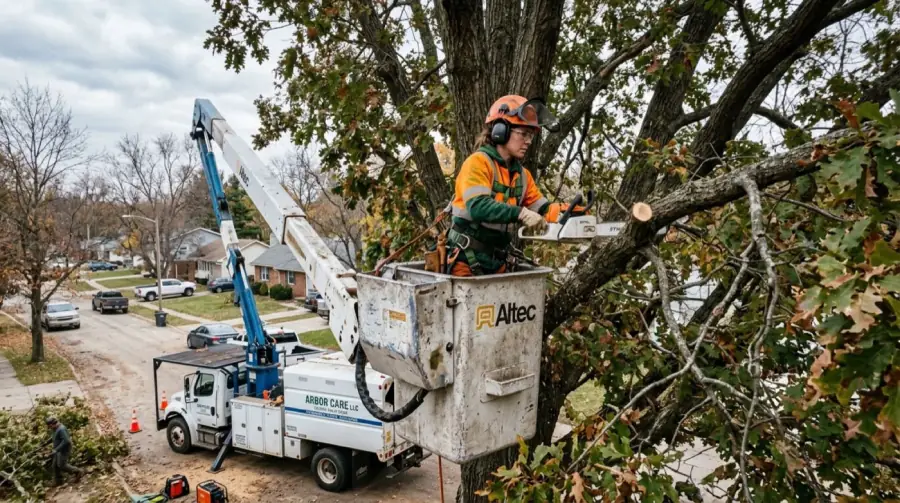
In Normanhurst (postcode 2076), tree work usually comes in three parts: keeping a tree in shape, taking out one that cannot stay, and putting something back. Removal is for trees that are dead, damaged or in the way, and each removal comes with a free tube-stock tree for the gap it leaves.
The crew is insured, is a member of Arboriculture Australia and has worked across Sydney's north west since 2004 from its base in Beecroft. You get a free assessment at your property and a written quote with a fixed price including GST before any work is booked.
Which tree services we cover in Normanhurst
Work in Normanhurst can include any of the following:
- Tree pruning: shaping, thinning and clearance cuts made to the Australian Standard.
- Tree removal: trees that cannot stay taken down in roped sections.
- Deadwood and hazardous trees: dead limbs cut out and storm-weakened trees made safe.
- Palm cleaning: fronds and pods taken off.
- Stump grinding: stumps ground away, leaving room to replant.
- Hedge and shrub trimming: included on request with any pruning job.
Find out how each one works on our list of tree services.
Tree pruning to AS 4373-2007
Pruning done properly leaves a tree healthier, not just smaller. Every cut follows AS 4373-2007, Pruning of Amenity Trees. The options include:
- Crown lifting to give clearance over a driveway, lawn or footpath.
- Crown thinning for a canopy so thick the garden underneath gets no sun.
- Crown reduction when a tree has simply grown too big for the block.
- Clearance cuts where limbs reach roofs, gutters, chimneys, windows or wires.
- Palm work, taking off dead fronds and seed pods.
Add hedges and shrubs to the quote and one visit covers the garden.
Hornsby Shire permits: where the exemptions stop
Normanhurst is part of Hornsby Shire. Before looking at what the council lets you do without a permit, check whether your property sits in an area where those allowances do not apply at all:
- a Heritage Conservation Area;
- a Locally Significant Ecological Community;
- an Endangered or Critically Endangered Ecological Community, or its 50 metre buffer.
Outside those areas, the council still expects a permit for most pruning and removal on private land, with each one assessed by a council arborist. The allowances are narrow. Nuisance branches, such as ones touching the roof, can be cut back by up to 10% of the canopy. A dead tree that is not native wildlife habitat, or a tree that is an imminent risk, can be removed after you give the council photo or video evidence and/or an arborist's written statement. Removing a healthy tree, or pruning past 10%, needs a permit.
The owner of the property signs the application, as tenants cannot give permission, and it can be lodged and paid online. The council's trees on private property page has the current details. When our arborist visits to quote, they can tell you whether the work is likely to need approval.
Removing a tree and replacing it
When a tree has to go, it is taken down in pieces rather than felled. A climbing arborist cuts sections from the top, and each one is lowered on ropes and pulleys so nothing crashes onto the roof, fence or garden. Some jobs suit a crane, which lifts sections out over the house and keeps the impact on the property low.
Common reasons for removal are storm damage, disease, root problems and trees blocking construction. Once the tree is down, you can take up the offer of a free replacement tube-stock tree, a chance to plant something better suited to the spot.
Deadwood and safety around the house
Dead branches are the parts of a tree most likely to drop without warning. Cutting them out is one of the simplest safety jobs on a property, and it is often done alongside other pruning. Trees left hazardous after a storm, and branches or trunks that have already come down, can be cleared as well.
One rule overrides everything else: if a tree or branch is touching a powerline, stay clear and call your electricity distributor.
Grinding the stump after the tree is cleared
With the tree cleared, the stump is the last piece. Grinding it out below the surface lets you replant, lay turf or pave the area. There are several sizes of grinder, which covers stumps in front and back yards, up steps, on slopes and right beside fences and retaining walls. The stump can be ground as part of the removal or quoted separately.
How the pricing works
Every price is worked out on site, because trees are not standard items. The arborist weighs up:
- how big the tree is and how much needs to come off or come down;
- access for the crew and equipment, and whether a crane is needed;
- what sits beneath the tree, like a roof, carport or pool;
- for stump grinding, the size of the stump, the access, any specialised equipment and how close it is to buildings.
You then receive a written quote that describes the work and gives one figure, GST included. The figure on the quote is the figure you pay.
Suburbs we cover around Normanhurst
The same crew works in the suburbs close to Normanhurst, including Waitara, Thornleigh, Wahroonga, Hornsby, Westleigh and Pennant Hills.
Booking a free assessment
Call 02 9133 4095 or use the online quote form. The arborist can look at the tree without coming inside, so you do not need to take time off to be there. Work is scheduled Monday to Friday between 7am and 5pm, with weekends available by appointment.
At the end, the property is cleaned up and the cuttings removed, unless you would like to keep the mulch or have the wood cut for firewood. The crew holds $20 million public liability insurance, and a copy can be sent on request.
Normanhurst tree removal questions
How much will it cost to remove my tree?
That depends on your tree. Its size, the access, what is underneath and whether a crane is needed all count. An arborist will look at it for free and give you a fixed written price including GST.
Do I need a Hornsby Shire permit for tree removal in Normanhurst?
In most cases. Hornsby Shire generally requires a permit to remove or prune a tree on private property. A dead tree that is not wildlife habitat, or one that is an imminent risk, can be removed without one once the council has received evidence.
Do I need council approval to prune or remove a tree on the North Shore?
Each council in northern Sydney has its own tree rules, so the answer changes with the address. For Normanhurst it is Hornsby Shire, where most pruning and removal needs a permit, apart from limited exemptions such as nuisance pruning of up to 10% of the canopy.
How does the pricing work?
After a free visit you get a written quote that describes the work and gives a single fixed price including GST. There is no set price per tree, because every job is different.
Which suburbs near Normanhurst do you cover?
Waitara, Thornleigh, Wahroonga, Hornsby, Westleigh, Turramurra and Pennant Hills are all nearby, along with Normanhurst itself. The crew is based in Beecroft.
Can you look after trees in a heritage conservation area?
Yes, but plan for a permit. Hornsby Shire's exemptions, including nuisance pruning and the dead tree exemption, do not apply in a Heritage Conservation Area, so work there generally needs council approval before it starts.
Do I get a new tree after a removal?
Yes. A free replacement tube-stock tree is offered with every removal.
Tree removal near Normanhurst
We also work in the suburbs around Normanhurst:
- Tree removal Waitara
- Tree removal Thornleigh
- Tree removal Wahroonga
- Tree removal Hornsby
- Tree removal Westleigh
- Tree removal Turramurra
- Tree removal Pennant Hills
- Tree removal Asquith
Ready to get a price? Request a free quote or call 02 9133 4095.